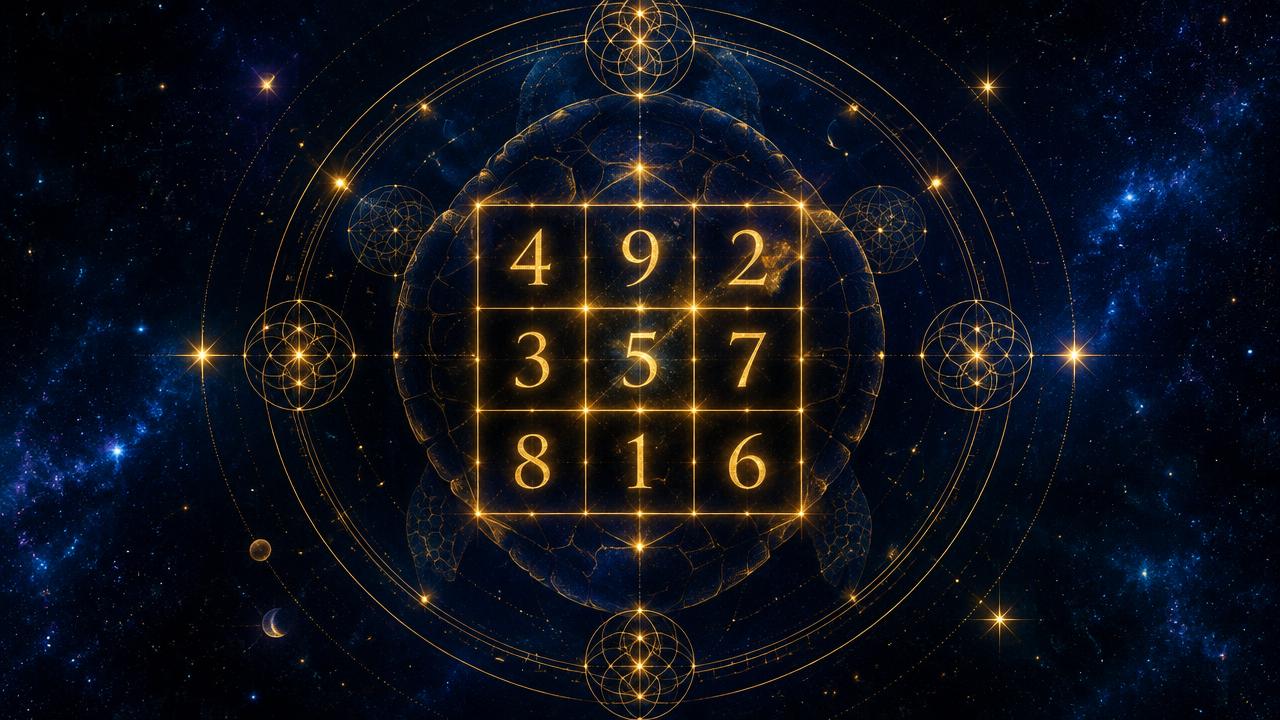
How the grid is built and what it says about character
The Lo Shu square is arranged 4-9-2 on the top row, 3-5-7 in the middle and 8-1-6 at the bottom. Every row, column and diagonal adds up to 15, which is why the square has been treated as a picture of balance for centuries.
To read your grid, every digit of your date of birth is placed in its own box; zeros are left out. A number that appears once is present, a number that appears two or more times is emphasised, and a box that stays empty is a missing number. Each number stands for a quality — 1 for self-expression, 5 for balance, 9 for idealism, and so on — so the pattern of full and empty boxes reads as a portrait of temperament.
- Date digits (zeros left out): 3, 1, 1, 1, 9, 6, 8
- Driver (Mulank): 31 → 3 + 1 = 4
- Conductor (Bhagyank): 3+1+0+1+1+9+6+8 = 29 → 11, placed as 2
White: from the date · Gold: added Driver and Conductor
- Missing numbers: 5, 7
- Repeated: 1 (3 times)
- Complete lines: Top row 4-9-2 · Bottom row 8-1-6 · Left column 4-3-8
Built by NumberHealer's own Lo Shu tool; master 11 is shown whole and placed on the grid as 2.
Career: the planes that show how you work
The grid is read in eight lines, called planes: the three rows, the three columns and the two diagonals. A complete plane is a strength the person can rely on at work; a broken one is where extra effort is needed.
The top row (4-9-2) is traditionally linked with thought and planning, the middle row (3-5-7) with will and feeling, and the bottom row (8-1-6) with practical action. Someone with a strong bottom row usually does best in hands-on, results-driven roles, while a strong top row suits planning, advisory and analytical work.
Money and business: the wealth and stability lines
For money, many readers look at the numbers linked with steady effort: 4 for discipline, 6 for responsibility and 8 for material results. When these boxes are filled, earnings tend to be steadier; when they are empty, income comes in waves and planning matters more.
The site's Lo Shu tool also uses the Sept 2026 notes method, which adds the Driver (Mulank), Conductor (Bhagyank) and Kua numbers to the grid. These extra numbers often fill a gap in the birth date, which is why two people with similar dates can read quite differently.
Study and learning
The number 3 box is linked with imagination and learning, and 1 with communication. Children whose grids lack both are often bright but find it hard to show what they know in examinations; parents usually see quick improvement once regular revision and speaking practice are built in.
Repeated numbers matter too. A doubled 1 is usually articulate, while a heavily repeated number can make a child one-sided. The grid helps parents see which subject habits to encourage, rather than labelling the child.
Home and property
Because the Lo Shu square comes from the same tradition as Vastu and Feng Shui, each box is also linked with a direction and an element. A missing number is sometimes supported by keeping that part of the home clean, well lit and uncluttered.
This is supportive guidance, not a substitute for a proper Vastu survey. The car and house tool on this site checks the house number itself against your birth numbers.
Names and the Lo Shu
The grid comes only from the birth date, so a name change cannot fill an empty box. What a name can do is support the missing quality, because the name number and its planet add their own energy to the chart.
That is why a good name correction is always checked against the Lo Shu grid as well as against the Mulank and Bhagyank.
Remedies for missing numbers
Each missing number has traditional remedies linked with its planet: a colour to wear more often, a day to observe, a simple mantra or a small daily habit. The Lo Shu tool on this site lists the remedy for each of your missing numbers and missing elements.
Remedies are usually followed for at least 40 days. They work best as steady habits rather than one-time rituals, and they never replace medical, legal or financial advice.