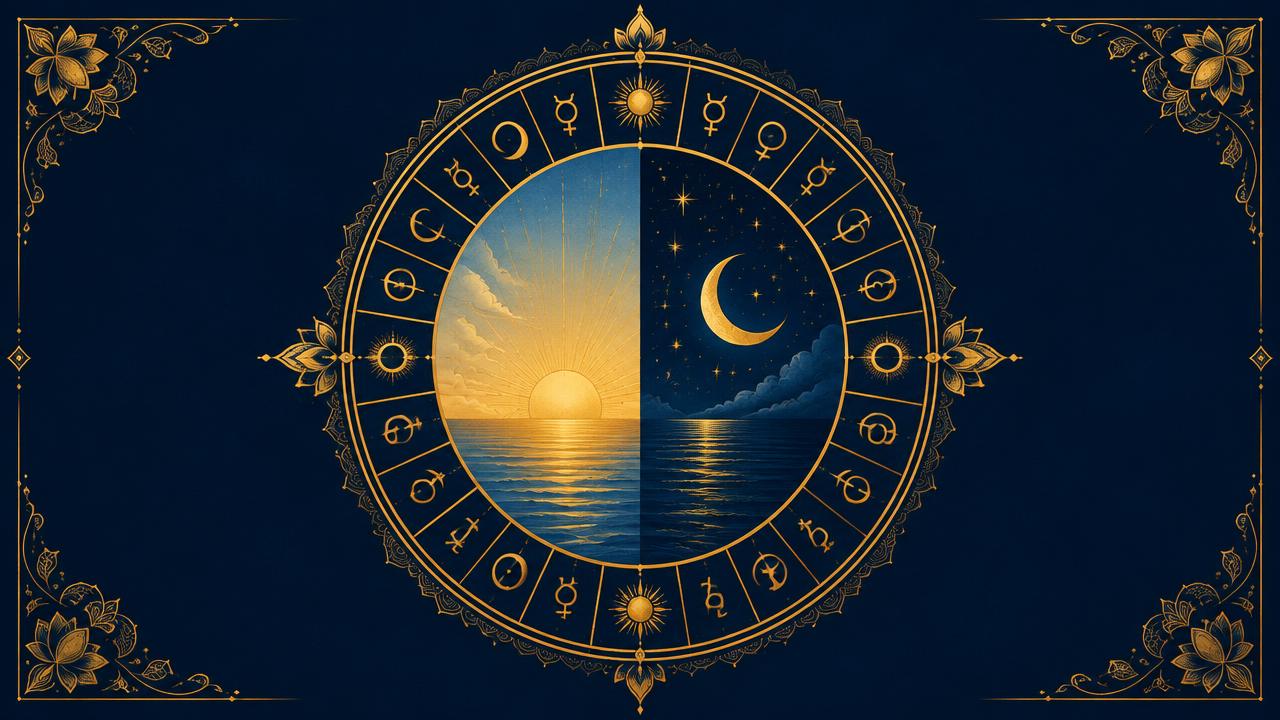
Hora in one sentence
A Hora is a planetary hour: a slice of the day ruled by one of the seven visible planets — Sun, Moon, Mars, Mercury, Jupiter, Venus and Saturn. The word is linked to 'Ahoratra', the Sanskrit word for a full day and night.
Why sunrise, not midnight
The Vedic day starts at sunrise. The daytime (sunrise to sunset) is divided into 12 equal Horas, and the night (sunset to the next sunrise) into another 12.
Because day and night change length through the year, a Hora is rarely exactly 60 minutes. In Delhi in June a day Hora lasts about 70 minutes and a night Hora about 50; in December it is the other way round.
Which planet rules the first Hora
The first Hora after sunrise belongs to the lord of the weekday: Sunday–Sun, Monday–Moon, Tuesday–Mars, Wednesday–Mercury, Thursday–Jupiter, Friday–Venus, Saturday–Saturn. This is where the weekday names themselves come from.
The fixed order of planets
After the first Hora, the planets follow in the order of their apparent speed, slowest to fastest, repeating: Saturn, Jupiter, Mars, Sun, Venus, Mercury, Moon. Starting from the day lord, you step forward through this cycle.
The sequence carries on through sunset without restarting. After 24 Horas it lands exactly on the next day's lord — a quick check that a table is correct.
How our Hora page works it out
Our Hora timing page calculates sunrise and sunset for your city and date from the Sun's real position, using the moment the Sun's upper edge touches the horizon with atmospheric bending allowed for — the rule most Indian Panchangs follow. All times are shown in the city's own clock time.
A time before sunrise belongs to the previous day's night Horas. In far-north places where the Sun does not set or rise, Hora cannot be calculated, and the page says so.
A quick worked example
Friday 21 June 2024, New Delhi: sunrise 05:24, sunset 19:22. Day length 13 h 58 min ÷ 12 ≈ 70 min per day Hora. Hora 1 (05:24–06:33) is Venus, as the lord of Friday; Hora 2 is Mercury, Hora 3 the Moon, Hora 4 Saturn, and so on.
Before you use Hora
Hora is one timing tool among several in a Panchang, alongside Tithi, Nakshatra, Rahu Kaal and Choghadiya. For big decisions a numerologist or astrologer weighs them together. Pending review: these meanings are drawn from common Vedic practice and still await review by NumberHealer's numerologist.